
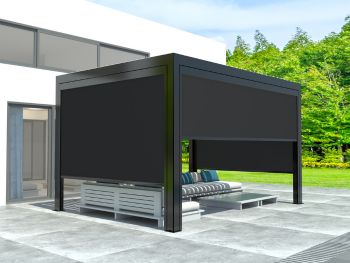
Weather Sensors and Awnings: Automated Protection Against Sun and Wind

You step outside to enjoy your terrace. The sun is too strong. You extend the awning manually. An hour later, the wind picks up while you are inside. The awning is still out. That is the moment most people wish their awning could just think for itself. An automated awning system with weather sensors does exactly that.
What Weather Sensors Actually Do
A weather sensor monitors outdoor conditions in real time and measures sunlight intensity, wind speed, and sometimes rain.
When the sensor detects a trigger, it sends a signal to the awning motor. The motor then extends or retracts the awning automatically based on the settings you choose.
You set the thresholds once. After that, the system handles it.
This means your awning responds to actual conditions, not a schedule or a guess. If a cloud rolls in and cuts the sun, the awning retracts. If the wind picks up past a safe level, it pulls back in. When conditions calm down, it extends again.
It sounds simple because it is. But the impact on daily life, and on the lifespan of your awning, is significant.
Sun Sensor Awnings: Shade When You Actually Need It
A sun sensor measures the intensity of sunlight hitting your outdoor space. You set a brightness threshold, and when sunlight reaches that level, the awning extends automatically.
Why this matters for homeowners
Direct sun through a window or onto a terrace can raise indoor temperatures noticeably. A sun sensor awning responds the moment sunlight gets strong enough to cause discomfort. You do not have to remember to extend it. The system handles it while you are busy doing something else.
Why this matters for hospitality and restaurant businesses
Guests sitting on your terrace should not have to squint or ask for the awning to be adjusted. Sun sensor awnings keep your outdoor seating comfortable without any staff having to monitor the weather all day. That is one less thing your team needs to think about during a busy service.
How the sun sensor works
Most sun sensors use a photovoltaic cell or light-dependent resistor to measure lux levels, which is a unit of light intensity. When the lux reading crosses your preset threshold, the controller triggers the motor. When light drops below that level, the awning retracts on its own.
You can usually adjust sensitivity settings to suit your location and how much shade you prefer. A south-facing terrace in the UAE needs different settings than a north-facing balcony in a cooler climate.
Wind Sensor Awnings: Protection You Cannot Afford to Skip
A wind sensor measures wind speed. When gusts reach a level that could damage your awning, the sensor triggers an automatic retraction.
This is not optional. It is essential.
Awnings are vulnerable to wind damage
An extended awning catches wind like a sail. Sudden gusts can bend the arms, tear the fabric, or strain the motor. Repair and replacement costs add up fast, especially for commercial installations.
Most wind damage happens when no one is watching. You are inside. The awning is out. A gust comes through and causes damage before anyone can react.
Wind sensor awnings remove that risk entirely.
How wind sensors work
Wind sensors typically use a spinning anemometer or a vibration-based detector to measure wind speed. When speed crosses a preset threshold, usually somewhere between 25 and 38 kilometres per hour depending on your awning model and location, the controller retracts the awning automatically.
Some systems also include a delay setting. This prevents the awning from extending again immediately after a brief gust, giving conditions time to fully settle before it deploys again.
Getting the threshold right
Set your wind threshold too low and the awning retracts constantly, even in light breezes. Set it too high and you risk wind damage before the sensor triggers. Your installer should help you find the right setting for your specific awning, your fabric weight, and your location.
In the UAE, where strong seasonal winds are common, a properly calibrated wind sensor is one of the most important parts of your outdoor setup.
Automated Awning System: More Than Just Motors
A basic motorized awning lets you press a button. An automated awning system goes further. It combines sensors, a smart controller, and a motor into a system that responds to the environment on its own.
Here is what a complete system typically includes:
The sensor unit. This monitors conditions outdoors. Quality matters here. A cheap sensor can give inconsistent readings, which leads to the awning behaving erratically.
The controller. This is the brain of the system. It receives signals from the sensor and tells the motor what to do. Better controllers allow for more customization, multiple sensor inputs, and integration with home or building automation systems.
The motor. This drives the awning in and out. A reliable tubular motor with the right torque for your awning size is essential. An underpowered motor wears out faster, especially if it has to fight wind resistance during retraction.
The awning itself. The fabric, the arms, and the housing all need to be built for your climate. In a hot, sunny, and sometimes windy environment like the UAE, material quality directly affects how long your system lasts.
Shade Pulse builds automated awning systems with all of these components working together. They design for the specific demands of the region, not just for general use.
Final Thoughts: Let Your Automated Awning System Do the Work
You bought an awning to make your outdoor space more comfortable and more useful. A system that relies on you to monitor the weather and manually adjust it every few hours is not really delivering on that promise.
An automated awning system with weather sensors gives you the full benefit of your investment. The sun comes out, the shade deploys. The wind picks up, the awning pulls back. You stay comfortable and your awning stays protected.
It is the kind of setup that quietly does its job every single day, and you only notice it because things just work.
Get A Free Quote