
How to Choose the Best Retractable Awning for Your Dubai Home or Café
An outdoor space that can’t be used half the year isn’t much of an outdoor space. Dubai’s summers are real. Intense sun from mid-morning, temperatures that make uncovered sitting areas genuinely unpleasant, and the need for shade that actually works rather than just technically existing.
A retractable awning in Dubai changes the equation. It turns a baking terrace, patio, or café seating area into somewhere people actually want to be. But the range of options is wide, and choosing wrongly means either underperforming shade or a product that won’t last in this climate.
Here’s what to think about before you buy.
Why Retractable Rather Than Fixed?
Fixed awnings or permanent shade structures work for spaces with consistent, year-round shade requirements. Retractable options give you something different: flexibility.
In Dubai, conditions vary enough throughout the day and year that flexibility matters. A retractable patio awning can be extended fully on a hot afternoon and retracted in the evening when you want open sky. It can come in during periods of strong wind. In the cooler months when Dubai’s outdoor climate is actually pleasant, you might want full sun rather than shade.
Fixed structures can’t do that. Retractable awnings give you control over your own outdoor environment rather than committing to one configuration permanently.
Choosing the Right Size: Don’t Underestimate Coverage
Awning sizing is where a lot of people get this wrong. They pick a size that looks reasonable and then find the awning doesn’t actually cover the space they need to use.
Measure your outdoor space before looking at products. Consider not just the footprint of the area but the sun angle, a south-facing terrace in the afternoon requires more coverage than you might expect because the sun comes at an angle. You may need the awning to extend further out than just over the seated area.
For café awnings in Dubai or commercial outdoor seating, coverage for the full customer seating area, with some margin, is the right starting point. Guests sitting at the edge of an awning in direct sun is not a great experience.
If in doubt between two sizes, go larger. Retracting unused awning is easier than shading a space an awning can’t quite cover.
Manual vs Motorised: The Honest Answer
The honest answer is: motorised awnings are almost always worth it for Dubai.
Manual retractable awnings work fine for smaller residential applications where you’re happy to crank an awning out on occasion. But for anything larger, anything in a commercial setting, or anywhere you want to use the awning frequently, motorised operation removes friction entirely.
You can deploy and retract at the touch of a button. Motorised awnings in Dubai can also integrate with wind sensors that automatically retract the awning if wind speed exceeds a set threshold, which is genuinely valuable for protecting the awning and the structure it’s attached to during unexpected weather.
The cost difference between manual and motorised options has reduced significantly, and the convenience benefit is disproportionate to the price gap.
Fabric Selection: UV Protection and Durability Are Non-Negotiable
One thing many homeowners don’t think about until later is how much punishment outdoor fabrics take in Dubai. A fabric that looks great when it’s first installed can start fading, looking tired, or losing its shape after a few years if it isn’t suited to the climate.
That’s why fabric choice matters. Some materials simply cope with the sun and heat better than others. For outdoor awnings in Dubai, fabrics that are designed for long-term sun exposure tend to hold their colour better, stay looking cleaner, and continue performing well even after years of daily use.
The fabric openness factor also affects performance. A denser fabric provides better UV protection and shade quality. A more open weave allows some light through and better air circulation underneath, more pleasant in some settings, less protective in others.
For commercial awnings, colour stability matters for branding consistency. A fabric that fades within two years is a problem aesthetically and practically.
Frame and Structure: What to Look For
The frame determines how long an awning will actually last and how it performs in wind.
Aluminium frames are the standard for outdoor awnings in Dubai. They’re lightweight, corrosion-resistant, and structurally sound. Avoid awnings with steel components that aren’t properly treated, as corrosion becomes a problem over time in any environment with humidity and salt air.
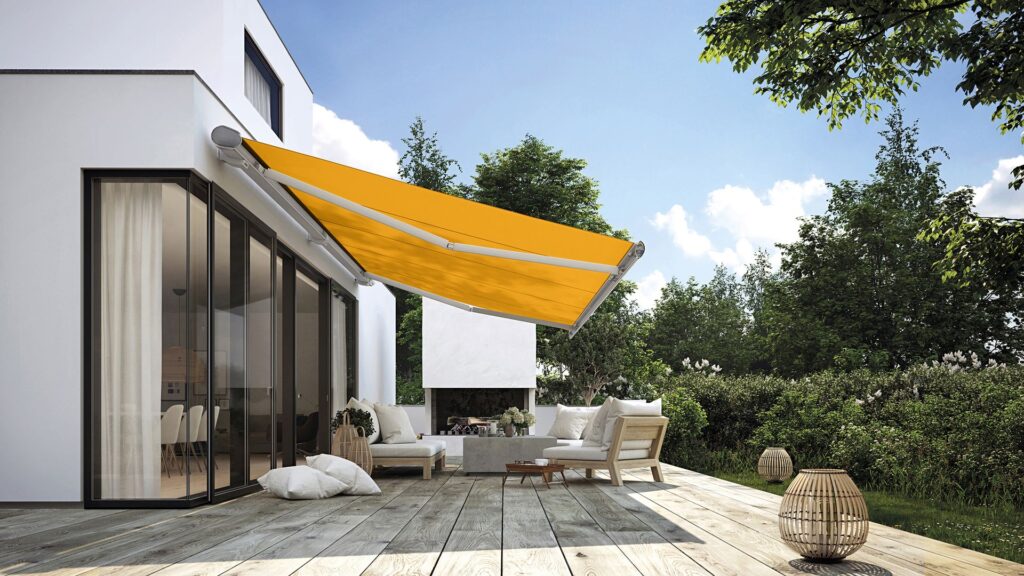
For motorised awnings, the arm mechanism matters too. Quality cassette awnings, where the fabric rolls into an enclosed housing, protect the fabric and mechanism from UV and dust when retracted. This significantly extends the product lifespan compared to open-arm designs.
Awning installation in Dubai should be done by experienced installers who understand the wind loads and fixing requirements for the wall or structure the awning is attached to. Poor installation is the most common cause of awning failure.
Commercial Awnings for Dubai Cafés and Restaurants
For café and restaurant operators, outdoor seating capacity directly affects revenue. An awning that makes outdoor seating usable for more of the day, and more of the year, has a direct financial return.
Commercial awnings need to be sized for proper coverage, use commercial-grade fabrics and mechanisms, and be installed to handle the higher usage frequency of a hospitality environment. Commercial-grade awnings are rated for significantly higher cycle counts than residential options, an important distinction when an awning is being deployed and retracted multiple times daily.
Branding customization, such as fabric colour matching, or printed signage, is also available on commercial awnings and worth considering for street-facing installations.
Shade Pulse: Retractable Awning Installation in Dubai
Every outdoor space has different requirements. A café may need flexible shade for customers throughout the day, while a homeowner may simply want to make a patio more comfortable during summer. Shade Pulse provides retractable awning solutions for both residential and commercial properties in Dubai, with options ranging from simple manual systems to motorised awnings with automation features.
Visit rmsdemo.com/projects/shadepulse/web/ to explore options, get sizing advice, and request a consultation for your space.
FAQs
What size retractable awning is best for a patio?
Measure your actual usable seating area first, then factor in sun angle for your specific orientation. As a rule, size up rather than down, an awning that doesn’t fully cover the space you want to use doesn’t solve the problem. For most standard residential patios, awnings in the 3 to 5 metre projection range cover practical seating areas effectively, but larger terraces need larger coverage.
Are motorised awnings better than manual options?
For most Dubai applications, yes. Motorised awnings are easier to use consistently, can integrate with wind sensors for automatic retraction, and can be operated remotely or on a schedule. The convenience factor means the awning actually gets used rather than staying retracted because operating it is an effort. For small, infrequently used awnings, manual options remain a reasonable choice.
How long do retractable awnings typically last?
With quality materials and proper maintenance, a well-specified retractable awning should last ten to fifteen years in Dubai conditions. Fabric typically has a shorter lifespan than the frame, six to ten years for quality UV-stable acrylic fabric, and can be replaced independently. Cassette-style awnings that protect the fabric when retracted generally outlast open-arm designs in this climate.
Can retractable awnings withstand strong winds?
Quality awnings with wind-rated arm mechanisms can handle moderate wind loads. Most manufacturers specify a maximum wind speed rating, typically around 30-50 km/h depending on the model. Motorised awnings with integrated wind sensors retract automatically when wind exceeds the set threshold, which protects the awning. No awning should be left deployed in strong winds or sandstorms.
Do awnings help lower indoor temperatures?
They can, especially if you have rooms that get blasted by the afternoon sun. If you’ve ever walked into a room that feels noticeably warmer than the rest of the house, chances are the sun is coming through the windows for several hours a day. An awning helps by keeping that direct sunlight off the glass in the first place.